Effective Date: 08/17/2026
Purpose
This Procedure establishes the minimum requirements for the safe operation of Mobile Elevating Work Platform (MEWP)’s also known as aerial lifts (boom or scissor lifts) in accordance with OSHA 29 CFR Part 1926.453 and American National Standards Institute (ANSI) A92.22. This applies to all employees who intend on using an aerial lift campus-wide.
Requirements
1. MEWP Operators
- 1.1. Only employees that have been trained by a licensed trainer (i.e United Rentals, Sunbelt, etc) for the specific manufacturer, make, and model of a MEWP are permitted to operate that MEWP under the following guidelines:
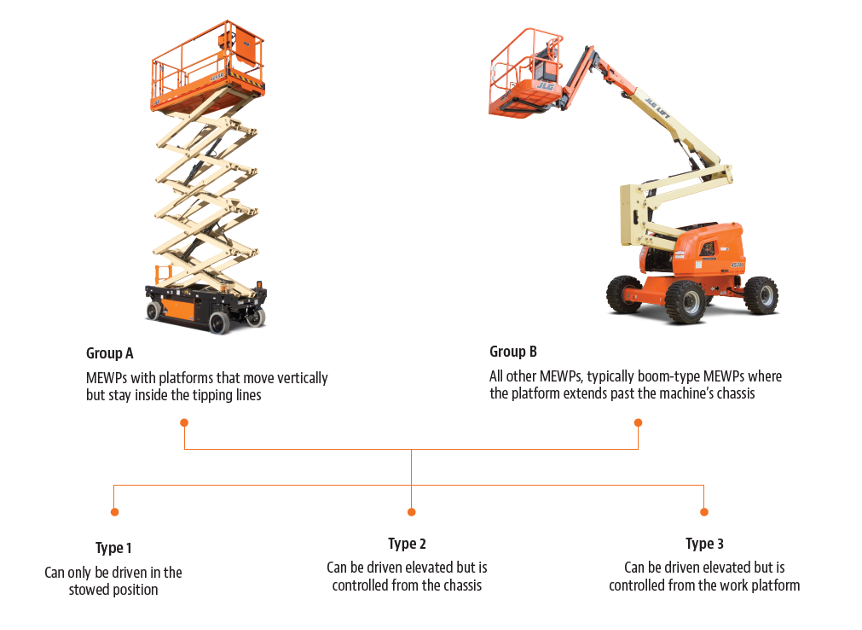
- 1.1.1. New MEWP Operator training for Group A and/or Group B MEWP shall include the following elements (Appendix A) :
- 1.1.1.1. thorough review of the operations manual provided by the manufacturer;
- 1.1.1.2. A demonstration of the pre-operation inspection, safety systems and operational controls;
- 1.1.1.3. An explanation of the MEWP’s capacity (maximum load) and limitations (stability);
- 1.1.1.4. The nature of the hazards specific to the work area and the correct procedures:
- 1.1.1.4.1. The hazards associated with operation near overhead electrical lines.
- 1.1.1.4.2. The hazards associated with the operation on irregular or inclined surfaces.
- 1.1.1.5. The proper use of the lift and the proper handling of materials on the MEWP;
- 1.1.1.6. Hands on skill verification to safely operate the MEWP.
- 1.1.2. Familiarization Training Employees who have completed new MEWP Operator training for Group A and/or Group B mobile elevating work platforms are not required to retake the full training.
- 1.1.2.1 Refresher Training is required every 3 years;
- 1.2.2.2 Or if the employee has show inadequacies in operating the lift
- 1.2.2.3 Or has been involved in an incident or near miss.
- 1.1.1. New MEWP Operator training for Group A and/or Group B MEWP shall include the following elements (Appendix A) :
- 1.2. Recordkeeping
- 1.2.1. All employees that are trained shall receive proof of training, the supervisor or employee shall provide the training record to Environmental Health and Safety for recordkeeping.
2. MEWP Occupants
- 2.1. An occupant is an employee who is not trained on the usage of the MEWP but is purely a passenger who can perform work from the lift basket. Occupants shall be provided with a basic understanding of the controls in case of an emergency.
3. General MEWP Requirements
- 3.1. Each MEWP must have the following manuals located in the weather resistant manual storage compartment on the MEWP:
- 3.1.1. The Operations and Safety Manual for the specific MEWP Model;
- 3.1.2. The ANSI Manual of Responsibilities for the MEWP Classification (2006);
- 3.1.3. Copy of the Company’s Mobile Elevating Work Platform Handbook; and
- 3.1.4. A MEWP inspection booklet .
- 3.1.5. Each MEWP is required to be equipped with the manufacturer’s legible original operating equipment decals, placards, and warnings that indicate special precautions or restrictions.
- 3.2. MEWP shall be equipped with a fully enclosed basket or a standard handrail system including a top rail, a mid-rail and a toe board with a self-closing gate.
- 3.2.1. All gates must be closed when the MEWP is being operated.
- 3.3. MEWP shall be equipped with a functioning back-up or travel alarm that is audible above the reasonably anticipated surrounding noise level.
- 3.4 MEWP’s shall not be loaded or operated in excess of the manufacturer’s rated capacity (i.e., load limit).
- 3.5 Employees shall not let pedestrians/other employees to walk beneath the basket of a MEWP where they could be inadvertently struck-by materials, tooling, or debris. Additional safety requirements include:
- 3.5.1 Barricades: Cones, danger tape, flaggers, sidewalk/road closures.
- 3.5.1.1 A logistics plan may be necessary depending on the nature of the work and if vehicle/pedestrian traffic may be effected.
- 3.5.2 Stow/secure tools and materials inside the basket during the movement of the lift / basket to prevent their unintentional release.
- 3.5.1 Barricades: Cones, danger tape, flaggers, sidewalk/road closures.
- 3.6 Employees shall wear a full body fall protection harness and an integrated lanyard, restraint device, or self-retracting lifeline that is connected to the back “D-Ring” on the employees harness and secured to the MEWP’s designated fall protection anchorage point.
- 3.7 Employees are to use only the manufacturer’s provided anchorage points. Employees shall not use the handrail as a fall protection anchorage point.
- 3.8 Each MEWP anchorage point shall only be used by one employee.
- 3.9 Scissors lifts, under normal use, do not require employees to tie-off. If an owner and/or client has a 100% fall protection policy for all lifts, the anchorage points designated on the lift must be utilized.
- 3.10 Employees must always stand on the floor of the MEWP basket and may not sit or climb on the edge of the basket of handrails.
- 3.10.1 The standing surface of the MEWP basket is to be kept clear of excess materials and debris.
- 3.10.2 Planks, ladders or other devices or materials may not be used as a work platform inside a MEWP.
4. Inspection and Records
- 4.1. Pre-Operation Inspection - Each MEWP shall be inspected and tested, which includes the lift controls and equipment operation, prior to use and/or at the beginning of each shift by the MEWP operator.
- 4.1.1. MEWP pre-operation inspections are to be documented in Pre-Operation MEWP Inspection Checklist Book that is to be kept on the unit at all times.
- 4.2. Annual Inspection - Each MEWP (i.e., owned, leased or rented) shall have a documented record of annual inspection.
- 4.2.1. Annual inspections are to be completed by a Qualified Person or Certified 3rd Party Trainer/Manufacturer of the lift.
Appendix A: